Showing posts with label WWII. Show all posts

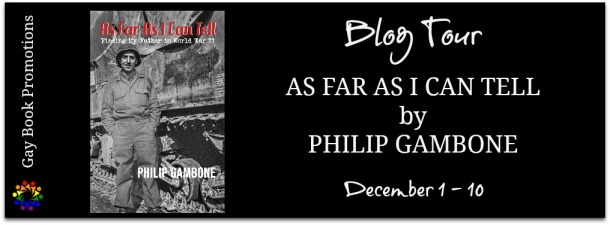
Blog Tour: As Far As I Can Tell: Finding My Father In World War II by Philip Gambone

Philip Gambone and Gay Book Promotions visit on the As Far As I Can Tell: Finding My Father In World War II blog tour! Interested in a WWII memoir? Discover more about the 2021 Lambda Literary Award nominated story from Rattling Good Yarns Press today!

BLOG TOUR
Book Title: As Far As I Can Tell: Finding My Father In World War II

Author: Philip Gambone

Publisher: Rattling Good Yarns Press

Release Date: October 30, 2020

Genre: Memoir

Trope/s: Father/Son Relationships

ThemesConnecting to the past, Understanding our fathers, 

Father/Son silence and the inherent lack of communications, 

Coming to terms with history

Heat Rating:  2 flames      

Length: 155 000 words/474 pages

It is a standalone book.

Goodreads


Buy Links

Publisher 

(Note – The Rattling Good Yarns online store only ships within the US)

Amazon US  |  Amazon UK 


2021 Lambda Literary Award Nominated

 
Blurb

Philip Gambone, a gay man, never told his father the reason why he was rejected from the draft during the Vietnam War. In turn, his father never talked about his participation in World War II. Father and son were enigmas to each other. Gambone, an award-winning novelist and non-fiction writer, spent seven years uncovering who the man his quiet, taciturn father had been, by retracing his father's journey through WWII. As Far As I Can Tell not only reconstructs what Gambone’s father endured, it also chronicles his own emotional odyssey as he followed his father’s route from Liverpool to the Elbe River. A journey that challenged the author’s thinking about war, about European history, and about “civilization."


"Philip Gambone weaves a moving memoir of his family, a vivid portrayal of his travels through the locales of WWII, and a powerful description of what that war was like to the men who fought it on the ground into a seamless and eloquent narrative." — Hon. Barney Frank, former Congressman, Massachusetts

“A single question pulses through As Far As I Can Tell: why didn’t my father talk about his time in the war? With meticulous research, Philip Gambone puts sound to silence, offering us a book-length love letter, not just to his father, but to anyone whose life has been hemmed in by obligation, obedience, and the brutality of the system. It’s also a coming to terms with the unknown in others, which is its own hard grace. A vital, dynamic read.” — Paul Lisicky, author of Later: My Life at the Edge of the World

As Far As I Can Tell is a fascinating mix of autobiography, travelogue, and historical research that not only takes us on a great adventure in search of what World War Two was like for those who fought in the European theater but probes that most difficult of all subjects, the relationship between a father and a son -- in this case, a gay son. Extensively researched, highly literate and profoundly thoughtful, the story Gambone tells uses not only soldiers’ memoirs but writers as disparate as Samuel Johnson and James Lord to make this a reader's delight.”— Andrew Holleran, author of Dancer from the Dance


Excerpt

On February 12, 1942, Dad reported for induction. The chief business was the physical examination, which was conducted assembly-line fashion. The inductees were naked, wearing only a number around their necks. It was the most comprehensive physical most of them had ever had. For some it was intimidating, for others embarrassing.

Most inductees were eager to pass the physical exam, so eager in fact that in many cases, they indulged in “negative malingering,” trying to conceal conditions that might get them disqualified. Once the physical was out of the way, the only screening that remained was a brief interview with an army psychiatrist, who had been instructed to look for “neuropsychosis,” a diagnosis that covered all sort of emotional ills from phobias to excessive sweating and evidence of mental deficiency.

Paul Marshall, who ended up in the same division as Dad, remembered being asked at his physical if he liked girls. “I didn’t quite understand what he meant about it. I told him, ‘Why sure, I like girls.’” Later Marshall figured out what he was really being asked. “The ultimate question mark of manliness,” James Lord, himself a homosexual, recalled. “Do you like girls? Or prefer confinement in a federal penitentiary for the remainder of your unnatural life.” The terror of being considered a sexual leper or worse, “unfit to honor the flag of your forebears,” was real. Lord answered, Yes, he liked girls, and was promptly accepted into the army.

Not every homosexual inductee lied. Some, like Donald Vining, came clean with his interviewer, who turned out to be “marvelously tolerant, taking the whole thing easily and calmly, without shock and without condescension.” The interviewer marked Vining’s papers “sui generis ‘H’ overt,” and he was out.

My father passed his induction physical. Hale, hearty, and decidedly heterosexual, he needed none of the remedial medical work—dental, optometric—that millions of other inductees did. With the physical and the psychological screenings done, Dad signed his induction papers, was fingerprinted, and issued a serial number. The final piece of business was the administration of the oath of allegiance, done, according to army regulations, “with proper ceremony.” Once sworn in, Dad was sent home to put things in order before he went off to Camp Perry to be processed for basic training.

Twenty-eight years after Dad’s, my own induction notice arrived, during my senior year in college. I was instructed to report to my hometown on May 6, where the Army would put me on a bus and drive me to the Armed Forces Examining and Entrance Station in South Boston. I remember standing, before dawn, on a curb outside the town offices waiting for the bus. Other fellows from my high school were there, and I nervously tried to make small talk with them. We’d had nothing in common in high school, and the situation hadn’t changed in the intervening years.

My recollection of that day is shrouded in numbness. I remember standing in a line, stripped to my underwear, making my way from one examining station to the next. I kept assuring myself I could not possibly go to Vietnam, that the good fortune I’d enjoyed so far would see me to a different destiny than the one where I would end up dead in a jungle in Southeast Asia.

I was clutching a letter from my dentist attesting to the fact that I needed braces, in those days a cause for rejection. But aside from that, I had not taken any steps to ensure that I wouldn’t be taken. I’d heard stories of guys planning to go to their induction physicals drunk, or stoned, or wearing dresses and makeup. Others said they would flee to Canada or apply for conscientious objector status. I had made no such plans. Throughout senior year, I had been sitting on my damn butt, still banking on magic or luck to get me the hell out.

I passed every exam. I was not overweight. I did not have flat feet or a heart murmur. My blood pressure was excellent. At one station, I handed over the dentist’s letter. The examiner gave it a perfunctory glance and tucked it into my file.

At last, I came to the psychological screening area. All I remember is the examiner asking me if I’d ever had any homosexual experiences. And when I said yes, he followed up with a few more questions. Had I sought counseling? Did I intend to stop? That was it. He thanked me and I moved on. Less than two weeks later, I received a notice from the AFEES: “Found Not Acceptable

for Induction Under Current Standards.” I’d been declared 4-F. In the parlance of the day, I had “fagged out.” My parents thought the dentist’s letter about braces had done the trick.


About the Author 

Philip Gambone is a writer of fiction and nonfiction. His debut collection of short stories, The Language We Use Up Here, was nominated for a Lambda Literary Award. His novel, Beijing, was nominated for two awards, including a PEN/Bingham Award for Best First Novel.

Phil has extensive publishing credits in nonfiction as well. He has contributed numerous essays, reviews, features pieces, and scholarly articles to several local and national journals including The New York Times Book Review and The Boston Globe. He is a regular contributor to The Gay & Lesbian Review.

His longer essays have appeared in a number of anthologies, including Hometowns, Sister and Brother, Wrestling with the Angel, Inside Out, Boys Like Us, Wonderlands, and Big Trips.

Phil’s book of interviews, Something Inside: Conversations with Gay Fiction Writers, was named one of the “Best Books of 1999” by Pride magazine. His Travels in a Gay Nation: Portraits of LGBTQ Americans was nominated for an American Library Association Award.

Phil’s scholarly writing includes biographical entries on Frank Kameny in the Dictionary of National Biography (Oxford) and Gary Glickman in Contemporary Gay American Novelists: A Bio-Bibliographical Critical Sourcebook. He also wrote three chapters on Chinese history for two high school textbooks published by Cheng and Tsui.

He is a recipient of artist’s fellowships from the MacDowell Colony, the Helene Wurlitzer Foundation, and the Massachusetts Arts Council. He has also been listed in Best American Short Stories.

Phil taught high school English for over forty years. He also taught writing at the University of Massachusetts, Boston College, and in the freshman expository writing program at Harvard. He was twice awarded Distinguished Teaching Citations by Harvard. In 2013, he was honored by the Department of Continuing Education upon completing his twenty-fifth year of teaching for the Harvard Extension School.


Author Links

Blog/Website  |  Facebook  |  Newsletter Sign-up


Hosted by Gay Book Promotions


Follow the tour and check out the other blog posts and interviews here


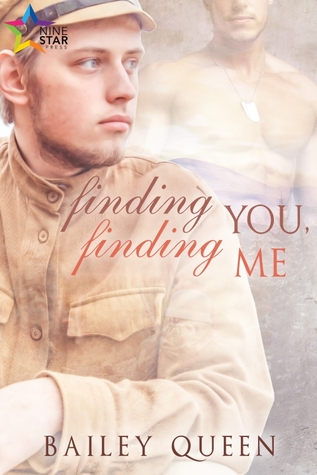
Review: Finding You, Finding Me by Bailey Queen

You're not supposed to find love in the middle of a war, and definitely not with someone in your same company.

Corporal Henry Iverson is 2nd Platoon's Doc. He loves his job, even if the guys don't quite love him back. Uneasy with the “company queer”, Henry is on the outs of everything, except when they need his help. He's used to being lonely, though, and he's got the tough skin to prove it.

Private Will Rollins joined the Army to get away from everything and everyone, but most especially from himself. Five thousand miles away, about to leap out of a plane over Utah Beach on D-Day, Will knows he's missing something in his life, but he told himself he wouldn't think about that. Not ever again.

When the jump doesn't go as planned, Henry finds Will – a man he barely knows from another platoon – injured behind enemy lines, and it's up to him to get Will to safety, despite the raging war and Will's sudden amnesia… and Will's out-of-seeming-nowhere searing attraction to Henry.

The war doesn't stop for two men, though, not for a moment. Stuck between endless battles and a world that shuns their form of love, Will and Henry must fight to survive the war and fight for each other, though everything stands in their way.


This is the perfect example how things that start out meh can turn into something utterly marvelous. When I read that Kleypas-y beginning I felt like rolling my eyes six ways to Sunday. I thought this was going to become my next big mistake.

Only it wasn’t.


Yes, I’m pretty lame myself, choosing a book with a guy with retrograde amnesia. I plead guilty. The plot says it all: simple, obvious and straight to the point. The character is in a situation of vulnerability and lacking all the social and personal inhibitions that used to stop him from showing his real emotions. But once that obstacle disappears, there is only the raw longings and desires. And the object of such desire is… yes, the other guy! As it should be.

Everything had a specific path and it was already written. Predictable, silly, definitely entertaining and, of course, with some PWP sex. Sounded like a plan!

I even made some popcorn. I was ready.

Only I wasn’t.

So, if you are looking for that book, you better start running now, because this is not a book for you.

This book lied to me on page 1 and I’m glad of that.

This book hides a beautiful story of two men with the enemies’ shots flying over their heads. This book is about jumping from planes, crashing into the ground and shutting down that afraid little voice in your head that begs you not to jump. This book is about weeks in the cold trenches in the middle of winter, with food running short, supplies at the minimum and only a dimming little hope to enlighten their hearts. A hope that they will make it to Christmas, to the end of the hell on Earth. This book is about those liberty days secluded in a room and scratching a moment here and there. About one more moment together, a moment together alive. And about comradeship and death.

It’s not a heavy book, and it’s not long either. But it’s definitely not the cheap version I pictured in my head when I decided to pick it up. Don’t let that cover fool you, it’s more epic than that. It’s much more than the amnesia easy plot. It’s of course, not a PWP novel. The ending surprised me, in a good way.

It’s worth reading.


Add to your shelf on Goodreads!

Purchase Links:


NineStar Press: http://ninestarpress.com/product/finding-you-finding-me/
Amazon: http://www.amazon.com/Finding-You-Me-Bailey-Queen-ebook/dp/B019MFRCS6


Interested in learning more about the author and "Finding You, Finding Me"? See an excerpt below.

Author Bio

Bailey Queen is the pseudo name of a romance and erotica author. She has been writing since 2001 and moved into the e-publications market in 2015. She has written action/adventure, mystery, drama, suspense, horror, romance, erotica, military, sci-fi, and fantasy. Much more will come from Bailey in each of these genres!
Find Bailey on Facebook to stay up to date with future publications!

Email: baileyqueenwrites@gmail.com
Facebook: https://www.facebook.com/profile.php?id=100009168238913

Excerpt

©Copyright Bailey Queen
All rights reserved

His bones were shaking.
Hell, even his guts were shaking, his internal organs, all the bits and pieces that made up his insides were rattling ’round. He couldn’t close his mouth, couldn’t grit his teeth because they would jackhammer together, probably crack and break, and then he’d really be up shit creek.
Will didn’t think there’d be any kind of dental care where they were going. Behind German lines. Behind Utah Beach.
Operation Overlord. It was really happening. He was stuck inside a C-47, rattling and banging around, his bones shaking right out of joint with the rest of his stick. They’d been flying long enough for everyone’s tightly wound fear to begin to wrestle with their boredom. Robertson messed with his clicker. Phillips, Ramirez, and Troy, all sergeants, shared a shaking cigarette at the end of the row.
Outside the plane, clouds hung low, as if they could just step out the jump door and bounce across the puffy surfaces. Hidden in the clouds were a thousand other planes holding thousands of other jumpers.
Thousands of other crazy, stupid, insane, suicidal idiots ready to leap through German hell. The welcome party was sure to be a blast. Will grimaced at his own terrible joke. Really, he didn’t expect to survive this. He’d enlisted because it was the right thing to do, ’cause fighting evil in the world was better than staying at home doing nothing or getting a crap job down at the mill. He’d been running; from what, he couldn’t remember anymore. There was boot camp, the airborne, and then there was the move to England. Training, every day, all day, and passing out exhausted on his cot with all of his teammates snoring next to him. He’d even been too tired to care about all that snoring.
And then, they were there, shuttling over the English Channel in what was going to be the last calm night of their lives, if not the last night of their lives. Will swallowed, shifting under the mountain of gear strapped to his body. He tried to lick his lips, but bit his tongue instead. He cursed and just let his jaw hang slack. He closed his eyes. If this was the end, this was the end.
Thinking about the end of his life made him remember things, things he didn’t want to remember. Times he’d tried to forget, feelings he’d desperately buried. Will shook his head, squeezing his eyes closed as he screwed up his face. No, he wasn’t going to die thinking of that. He’d buried it. He had.
The cloud bank outside the jump door disappeared, replaced with a slap of crisp night air and the firecracker splatter of tracer fire. Pops of bursting light bloomed, shattering the stillness of the hold, followed by the heavy crack of anti-aircraft guns firing from somewhere down below. Like the sound of tree trunks cracking, snapping in half as if a giant’s twigs, the booming snaps and flickering lights tore into Will, into everyone, in a way they hadn’t expected.
Then a roaring whine and the sound of engines straining. Their plane, rolling, banking, rising. All around them, planes were on fire, splitting in half. Parachutes opened. They weren’t even at the DZ yet, they couldn’t be. Will hauled himself to his feet as his lieutenant called out the order to stand ready. He hooked his line, checked his jump partner, and felt his teammate behind him check him. They rocked and rolled on unsteady feet as the plane continued to bank and shudder beneath them.
New sounds burst to life, creaking and groaning. Their fleet, their airplanes, split in half. Frantic cursing came from the cockpit after another hard roll.
“Get them out, now!” Will didn’t know how, but he heard the pilot’s angry shouting, and then the light at the edge of the jump door turned green, and the lieutenant leapt through the opening.
They all followed, waddling as fast as they could, relying on the training they’d repeated until they waddled to the latrines in the same way. Will couldn’t think of anything, couldn’t remember his name, couldn’t even say a single word, but his training had his body moving toward the door, gripping the frame, and hurling himself into the black French sky.
His chute ballooned open above him. First miracle. Exhaling, Will tried to look around, tried to orient himself. Parachutes were everywhere, falling above and beneath him. Tracer fire lit the sky, zinging hot and sharp into the metal bellies of their planes and whumping into the open canopies of the chutes in the sky.This is it. Tracer fire will take me out. I’ll burn alive in the sky. Or my chute will burn above me, and I’ll splatter to the ground.
But the ground was coming up quickly. Quicker than it was supposed to. His body knew, from all the training, what a jump at the proper altitude felt like. How many breaths he’d have. How much time he’d have.
There wasn’t enough time. The trees were coming in fast—and wasn’t that just the luck, to land in fucking trees? He shifted, trying to steer, trying to move, but the trees were everywhere, suddenly right there, and he knew he’d slam right into them. He’d jumped too low—the plane, diving and climbing and rolling to evade fire had missed the altitude window, and they’d all dropped in the middle of the plane’s maneuvers. They’d jumped at different altitudes, and now they were scattered. Will didn’t see anyone else near him, near enough to slam into the trees with him, and he curled up as best he could. He wrapped his arms around his face and spat every curse he knew as he slammed into the branches.
* * * * *
Groaning, Henry lay on his side for another moment, letting the tall French grass conceal his position. He knew he had to move, but he just couldn’t. Not yet.
The jump had jarred every bone in his body. He’d executed the parachutist landing, had felt all five points hit, but damn. That hurt. Before he knew it, he was stripping his chute harness, undoing his helmet, and sliding the inflatable life vest over his head. Henry hauled his gear up, situating his medic pack and doing a quick check to make sure everything was there. Rifle in one hand, Henry clicked his cricket and waited.
And waited.
Silence.
“Fuck me,” he whispered. The whole jump had been a scattered mess, burning planes falling from the sky, anti-aircraft fire everywhere. He’d jumped from his plane before it had blown, and he thought all the others made it out when he did. The plane, a fireball rolling through the night, had hit the ground before he had.
And now, he was alone, God knew where, with no idea of the others’ locations.
Closing his eyes, Henry listened, trying to hear anything at all. He’d lost the booming roar of the anti-aircraft guns and the rumble of the planes overhead. It was deceptively quiet, almost peaceful, and the silence was grating on his nerves. He’d expected anything else. Weapons fire, screaming, calls for “medic!” Anything but this.
Staying low, Henry ran to the nearest tree line. At the very least, he would find cover and try to orient himself. He was a medic. He needed to be with his troops. Even if, generally, they didn’t want him anywhere near them. “Queer,” they called him to his face. “Faggot” when they thought he couldn’t hear. It was Doyle who had started it, way back in basic, and it was just his luck to keep Doyle in his platoon all through Airborne and into England. The rest of the guys had followed Doyle’s lead. Still, even though they were distant and cold, they came to him for aspirin, bandages, and advice on what to do with the sore on their crotch after a weekend in Bristol.
Sharp eyes, a disapproving glare, and some ointment later, the troops were on their way.
Combat would change everything, like training on some kind of ultimate high. The happiest Henry had been was on those long, miserable, awful training exercises. In the pouring rain, miserable and full of piss and vinegar, they’d all huddled together in their holes and tried to cheer each other up. It had been the first time he’d been able to laugh with the guys in his platoon, and they with him. Though they’d all conveniently forgotten about it by the time they were back at camp, he still wanted to do his part. Yeah, the guys in his platoon were jerks, but they were all right. Generally. Gillen had a kid back home. Giordano was the clown, leading the rest of his gaggle on some grand adventure every liberty. Doyle was a jerk, but he couldn’t change that.
He wanted to find his platoon, wanted to be with them.
Looking around, Henry dropped to one knee at the tree line and dug for his map. It showed the drop zone, the attack routes, where they were supposed to be. It did nothing for him now, though—lost, with no idea where he was. He swore again, shoving the map back in his pants.
A low groan caught Henry’s attention, and he froze.
The groan sounded again, louder, along with a curse. There was a shifting in the leaves and the branches on the ground and then the snap of a twig.
Moving slowly, one foot crossing over the other, Henry crept deeper into the woods. Silently, he breathed through his mouth, open and measured, and raised his rifle. He wasn’t supposed to fight, but he was supposed to defend himself, and all alone in the German woods with God only knew what in front of him, he was going to Goddamn defend himself.
Except, whatever was groaning seemed to be in pain. And…human. And…alone.
Henry rolled from behind the tree trunk he’d crouched behind with rifle raised and pointed directly at the groaning man on the forest floor. “Flash,” Henry hissed, using the call and response challenge he’d had drilled into his brain.
“Son of a bitch…” Rolling toward Henry, the man frowned up at him, one hand on his head. “The fuck are you pointing a rifle at me for?”