Showing posts with label history. Show all posts

Blog Tour: As Far As I Can Tell: Finding My Father In World War II by Philip Gambone

Philip Gambone and Gay Book Promotions visit on the As Far As I Can Tell: Finding My Father In World War II blog tour! Interested in a WWII memoir? Discover more about the 2021 Lambda Literary Award nominated story from Rattling Good Yarns Press today!

BLOG TOUR
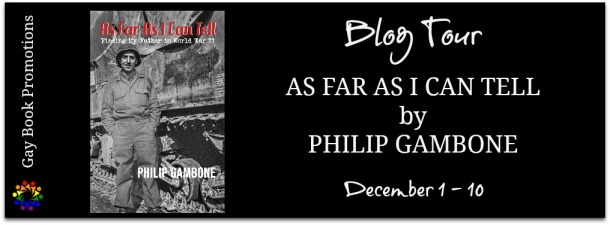
Book Title: As Far As I Can Tell: Finding My Father In World War II

Author: Philip Gambone

Publisher: Rattling Good Yarns Press

Release Date: October 30, 2020

Genre: Memoir

Trope/s: Father/Son Relationships

ThemesConnecting to the past, Understanding our fathers, 

Father/Son silence and the inherent lack of communications, 

Coming to terms with history

Heat Rating:  2 flames      

Length: 155 000 words/474 pages

It is a standalone book.

Goodreads


Buy Links

Publisher 

(Note – The Rattling Good Yarns online store only ships within the US)

Amazon US  |  Amazon UK 


2021 Lambda Literary Award Nominated

 
Blurb

Philip Gambone, a gay man, never told his father the reason why he was rejected from the draft during the Vietnam War. In turn, his father never talked about his participation in World War II. Father and son were enigmas to each other. Gambone, an award-winning novelist and non-fiction writer, spent seven years uncovering who the man his quiet, taciturn father had been, by retracing his father's journey through WWII. As Far As I Can Tell not only reconstructs what Gambone’s father endured, it also chronicles his own emotional odyssey as he followed his father’s route from Liverpool to the Elbe River. A journey that challenged the author’s thinking about war, about European history, and about “civilization."


"Philip Gambone weaves a moving memoir of his family, a vivid portrayal of his travels through the locales of WWII, and a powerful description of what that war was like to the men who fought it on the ground into a seamless and eloquent narrative." — Hon. Barney Frank, former Congressman, Massachusetts

“A single question pulses through As Far As I Can Tell: why didn’t my father talk about his time in the war? With meticulous research, Philip Gambone puts sound to silence, offering us a book-length love letter, not just to his father, but to anyone whose life has been hemmed in by obligation, obedience, and the brutality of the system. It’s also a coming to terms with the unknown in others, which is its own hard grace. A vital, dynamic read.” — Paul Lisicky, author of Later: My Life at the Edge of the World

As Far As I Can Tell is a fascinating mix of autobiography, travelogue, and historical research that not only takes us on a great adventure in search of what World War Two was like for those who fought in the European theater but probes that most difficult of all subjects, the relationship between a father and a son -- in this case, a gay son. Extensively researched, highly literate and profoundly thoughtful, the story Gambone tells uses not only soldiers’ memoirs but writers as disparate as Samuel Johnson and James Lord to make this a reader's delight.”— Andrew Holleran, author of Dancer from the Dance


Excerpt

On February 12, 1942, Dad reported for induction. The chief business was the physical examination, which was conducted assembly-line fashion. The inductees were naked, wearing only a number around their necks. It was the most comprehensive physical most of them had ever had. For some it was intimidating, for others embarrassing.

Most inductees were eager to pass the physical exam, so eager in fact that in many cases, they indulged in “negative malingering,” trying to conceal conditions that might get them disqualified. Once the physical was out of the way, the only screening that remained was a brief interview with an army psychiatrist, who had been instructed to look for “neuropsychosis,” a diagnosis that covered all sort of emotional ills from phobias to excessive sweating and evidence of mental deficiency.

Paul Marshall, who ended up in the same division as Dad, remembered being asked at his physical if he liked girls. “I didn’t quite understand what he meant about it. I told him, ‘Why sure, I like girls.’” Later Marshall figured out what he was really being asked. “The ultimate question mark of manliness,” James Lord, himself a homosexual, recalled. “Do you like girls? Or prefer confinement in a federal penitentiary for the remainder of your unnatural life.” The terror of being considered a sexual leper or worse, “unfit to honor the flag of your forebears,” was real. Lord answered, Yes, he liked girls, and was promptly accepted into the army.

Not every homosexual inductee lied. Some, like Donald Vining, came clean with his interviewer, who turned out to be “marvelously tolerant, taking the whole thing easily and calmly, without shock and without condescension.” The interviewer marked Vining’s papers “sui generis ‘H’ overt,” and he was out.

My father passed his induction physical. Hale, hearty, and decidedly heterosexual, he needed none of the remedial medical work—dental, optometric—that millions of other inductees did. With the physical and the psychological screenings done, Dad signed his induction papers, was fingerprinted, and issued a serial number. The final piece of business was the administration of the oath of allegiance, done, according to army regulations, “with proper ceremony.” Once sworn in, Dad was sent home to put things in order before he went off to Camp Perry to be processed for basic training.

Twenty-eight years after Dad’s, my own induction notice arrived, during my senior year in college. I was instructed to report to my hometown on May 6, where the Army would put me on a bus and drive me to the Armed Forces Examining and Entrance Station in South Boston. I remember standing, before dawn, on a curb outside the town offices waiting for the bus. Other fellows from my high school were there, and I nervously tried to make small talk with them. We’d had nothing in common in high school, and the situation hadn’t changed in the intervening years.

My recollection of that day is shrouded in numbness. I remember standing in a line, stripped to my underwear, making my way from one examining station to the next. I kept assuring myself I could not possibly go to Vietnam, that the good fortune I’d enjoyed so far would see me to a different destiny than the one where I would end up dead in a jungle in Southeast Asia.

I was clutching a letter from my dentist attesting to the fact that I needed braces, in those days a cause for rejection. But aside from that, I had not taken any steps to ensure that I wouldn’t be taken. I’d heard stories of guys planning to go to their induction physicals drunk, or stoned, or wearing dresses and makeup. Others said they would flee to Canada or apply for conscientious objector status. I had made no such plans. Throughout senior year, I had been sitting on my damn butt, still banking on magic or luck to get me the hell out.

I passed every exam. I was not overweight. I did not have flat feet or a heart murmur. My blood pressure was excellent. At one station, I handed over the dentist’s letter. The examiner gave it a perfunctory glance and tucked it into my file.

At last, I came to the psychological screening area. All I remember is the examiner asking me if I’d ever had any homosexual experiences. And when I said yes, he followed up with a few more questions. Had I sought counseling? Did I intend to stop? That was it. He thanked me and I moved on. Less than two weeks later, I received a notice from the AFEES: “Found Not Acceptable

for Induction Under Current Standards.” I’d been declared 4-F. In the parlance of the day, I had “fagged out.” My parents thought the dentist’s letter about braces had done the trick.


About the Author 

Philip Gambone is a writer of fiction and nonfiction. His debut collection of short stories, The Language We Use Up Here, was nominated for a Lambda Literary Award. His novel, Beijing, was nominated for two awards, including a PEN/Bingham Award for Best First Novel.

Phil has extensive publishing credits in nonfiction as well. He has contributed numerous essays, reviews, features pieces, and scholarly articles to several local and national journals including The New York Times Book Review and The Boston Globe. He is a regular contributor to The Gay & Lesbian Review.

His longer essays have appeared in a number of anthologies, including Hometowns, Sister and Brother, Wrestling with the Angel, Inside Out, Boys Like Us, Wonderlands, and Big Trips.

Phil’s book of interviews, Something Inside: Conversations with Gay Fiction Writers, was named one of the “Best Books of 1999” by Pride magazine. His Travels in a Gay Nation: Portraits of LGBTQ Americans was nominated for an American Library Association Award.

Phil’s scholarly writing includes biographical entries on Frank Kameny in the Dictionary of National Biography (Oxford) and Gary Glickman in Contemporary Gay American Novelists: A Bio-Bibliographical Critical Sourcebook. He also wrote three chapters on Chinese history for two high school textbooks published by Cheng and Tsui.

He is a recipient of artist’s fellowships from the MacDowell Colony, the Helene Wurlitzer Foundation, and the Massachusetts Arts Council. He has also been listed in Best American Short Stories.

Phil taught high school English for over forty years. He also taught writing at the University of Massachusetts, Boston College, and in the freshman expository writing program at Harvard. He was twice awarded Distinguished Teaching Citations by Harvard. In 2013, he was honored by the Department of Continuing Education upon completing his twenty-fifth year of teaching for the Harvard Extension School.


Author Links

Blog/Website  |  Facebook  |  Newsletter Sign-up


Hosted by Gay Book Promotions


Follow the tour and check out the other blog posts and interviews here


Review: Wight Mischief by J.L. Merrow

A ghost of a chance at love.

Personal trainer Will Golding has been looking forward to a getaway with his best friend, Baz, a journalist researching a book on ghosts. But on the first day of their camping trip on the Isle of Wight, Will takes a walk on a secluded beach and spies a beautiful young man skinny-dipping by moonlight. Ethereally pale, he’s too perfect to be real—or is he?

Lonely author Marcus Devereux is just as entranced by the tall athlete he encounters on the beach, but he’s spent the years since his parents’ violent death building a wall around his heart, and the thought of letting Will scale it is terrifying. Marcus’s albinism gives him his otherworldly appearance and leaves him reluctant to go out in daylight, his reclusiveness encouraged by his guardian—who warns him to stay away from Will and Baz.

The attraction between Will and Marcus can’t be denied—but neither can the danger of the secrets haunting Marcus’s past, as one “accident” after another strikes Will and Baz. If they don’t watch their step, they could end up added to the island’s ghostly population.


I read Wight Mischief for the first time in 2013 and while I didn’t remember a lot of details, the imagery still was with me when the book came through the blog for its re-release. I really wanted to visit the Isle of Wight again through J.L. Merrow’s words and I enjoyed it just as much the second time around.

Wight Mischief plays to J.L. Merrow’s strengths with vivid atmospheric imagery and characters who come to life on the pages. I had a real soft spot for Will throughout. Every reader knows the warm fuzzy feeling of connecting and rooting for a character with all their literary loving heart. Will was my dude. He was everything I love wrapped in a big, beautiful humble package. His unwavering loyalty and one sided crush on Baz frustrated me to no end, but I also understood it given their age and history.

Myself, I love a mystery and one with a paranormal bent is even better. The ghost hunting angle that came with Baz’s research set the scene for the tension that flows from start to finish. The research leads them to Marcus’s doorstep and the connection between Marcus and Will was obvious, but also not easy. Marcus is a successful author with a mysterious past and an overbearing caretaker who adds some delicious tension and a character I could love to hate. The story needed a clear villain and Leif delivered.

The mystery evolves along with Marcus and Will’s relationship. I liked reading about Will’s change of affection from Baz to Marcus. It was refreshing and I was happy reading about Will’s happiness. Their relationship wasn’t without its angst but the angst wasn’t overdone considering everything else going on.

And there was a lot going on. Honestly if you are looking for full blown romance, you are going to be a little disappointed. Will and Marcus don’t have a ton of page time together, but the time they do have is intense and they do spend a lot of time pining for one another. That did make the end that much sweeter for me as their HEA was well earned.

Wight Mischief has characters to love, to hate and ones you want to throttle. There’s the mystery, the ghost stories and the Isle of Wight itself which is a character all on its own. I quite enjoy reading a story with all manner of elements and a mystery needs a lot of movement to keep the reader, well, mystified and engaged. Because there were the other elements in the story as well; the romance between Will and Marcus, the changing dynamics between Will and Baz, the new friendships made, etc., the mystery didn’t have to be overly complex and I’m glad it wasn’t. I wanted to read about it, but I didn’t want it to outshine Will and Marcus. In the end the balance worked for me as a mystery lover with bonus romance.


**a copy of this story was provided for an honest review**


Review: As Sure As The Sun (Accidental Roots #4) by Elle Keaton

The universe is trying to tell Sacha Bolic something. A fire escape collapses under him, he lands in crap, and a killer barely misses his target... all in the same few seconds. That's on top of a long list of mishaps and job dissatisfaction. Not one to ignore signals when they're shoved in his face, Sacha retires and uses his savings to buy an old building in Skagit, Washington. With a little help from DIY videos, he’s going to bring it back to its former glory.  And, yeah, it’s a metaphor. If he makes one change, others will follow…

Seth Culver avoids entanglements, romantic or otherwise. Who needs them? He’s learned the hard way that people betray you or leave. Still, Seth finds people compelling. He kind of collects them, learning their secrets before letting them go their own way. His commitment to no commitments may have met its match in Sacha. Handsome and hot, Sacha seems to offer a permanence that scares Seth more than anything ever has. Seth will have to decide if he’s going to grab life by the balls or keep watching from the sidelines.

A box of inconsequential belongings hidden for decades in the old building hints at lives imagined but not lived, reminding them both there are no guarantees in love, or this thing called life.


As Sure as the Sun is quieter than it's predecessors but I found I didn't mind that aspect at all.  Sometimes it's nice to read a simple love story without all the murder and mayhem getting in the way.
  
I've been wanting to read Sacha's book ever since I met him in book two.  He intrigued me with his stoicism and curmudgeonly ways and I wanted to get to know the man underneath the scowl.  Turns out, he is a beautiful, lonely soul looking to make his life more complete.  He's led a rough life - born in a war torn eastern European country, growing up in foster care after emigrating to the states and putting his life on the line daily as a US Marshal while keeping himself in the closet.  He's tired and worn out and he's had enough so he decides it's time to retire and pursue what he really wants out of life.  He moves to Skagit, the town where he spent a couple of years deep undercover as a mob goon, and purchases an historic building, intent on restoring it.

Sparks fly when he meets Seth, another recent transplant to Skagit.  There is an instant attraction between the two that leads Seth to offer things he normally wouldn't to a complete stranger, namely a place to shower and launder Sacha's clothes since Sacha has done without due to living in the building while restoring it.  Both find they have quite a bit in common; their love of history and old buildings being among them.

Seth reminded me of a puppy, bouncing around and getting excited over the simplest things.  He put on a great face, that of a carefree life full of love and happiness.  But, it's just a face, a facade.  Underneath the smiles and laughter is a scared little boy who just wants to belong to someone.  

I enjoyed watching these two navigate through their blossoming relationship, first as friends, then as lovers.  I feel they stayed true to themselves throughout the story, even when they weren't sure who they were at all.  They had a lot to overcome and I felt their reactions and the decisions they made, even the bad ones, were realistic.  I could understand why Seth did what he did though it upset me.  And I'm glad Sacha was strong enough to put his insecurities aside and pursue his happiness.

And there was still a mystery here, just not prominent in the story.  It was a bit heartbreaking to read about the two men in the photograph Sacha found hidden behind a wall in the building he's restoring but it was also hauntingly beautiful.  It made me tear up a little bit.

This was a great addition to the Accidental Roots series and I can't wait to read the next book.  Elle Keaton has proven to be a talented author and, frankly, I just like how she writes.  The storyline is smooth and easy to follow.  Bits of humor interjected  here and there bring levity where it's needed to keep the story from becoming too maudlin.  And it's just plain interesting.  I want to know more.  

Recommended to, well, pretty much everyone.  If you haven't given this author a try I urge you to do so.  This, and her other stories, are worth the read.


https://www.goodreads.com/book/show/36229057-as-sure-as-the-sun


Review: The Mystery of the Curiosities (Snow & Winter #2) by C.S. Poe

Life has been pretty great for Sebastian Snow. The Emporium is thriving and his relationship with NYPD homicide detective, Calvin Winter, is everything he’s ever wanted. With Valentine’s Day around the corner, Sebastian’s only cause for concern is whether Calvin should be taken on a romantic date. It’s only when an unknown assailant smashes the Emporium’s window and leaves a peculiar note behind, that all plans get pushed aside in favor of another mystery.

Sebastian is quickly swept up in a series of grisly yet seemingly unrelated murders. The only connection tying the deaths together are curiosities from the lost museum of P.T. Barnum. Despite Calvin’s attempts to keep Sebastian out of the investigation, someone is forcing his hand, and it becomes apparent that the entire charade exists for Sebastian to solve. With each clue that’ll bring him closer to the killer, he’s led deeper into Calvin’s official cases.

It’s more than just Sebastian’s livelihood and relationship on the line—it’s his very life.


This is really turning into a fun series and I believe I enjoyed the second even more than the first. Most probably because when book #1 ended, Sebastian and Calvin were still very “new” and there was a lot of evolution in their relationship in book #2 that I absolutely loved reading.

The mystery kept me connected in a fun and engaging way. If you’re looking for plot twists, turns and surprises at the end of every chapter, this is not that story and I was perfectly fine with that. I read this while on a long weekend away decompressing and this was the perfect level of mysterious for that setting. It was fun while interesting and I didn’t have to think about it too hard to keep up. I could follow along with Sebastian’s OTT shenanigans and just enjoy the ride. Was it realistic for Sebastian to insert himself into police investigations? Of course not, but I didn’t come here for the absolute reality, I came for Sebastian, Calvin, their secondary characters; the mystery-lite was a bonus. Shit happens to Sebastian because it does, that’s all I really need to know to wallow in Snow & Winter happily.

I do so love the quirk and the snark Sebastian and Calvin share, but their relationship carries some extra weight in book 2. Neither of these guys are kids and it’s refreshing to read about two characters who are getting into a relationship while also have some history that they are both working through. As we get older, we become a culmination of our experiences and that is so true for both of these guys. The story was really well balanced between the thrill of new love and the gravity of the past. Calvin’s path could have been a story in itself, but the author kept the tone even enough so that there was no question as to the pain and struggle Calvin lived with, but the chance of new love kept the story hopeful even through the worst of times described.

Major props to Sebastian’s dad, the man is a rock that both Calvin and Sebastian need and he’s one of those quiet, yet amazing characters that hits you right in the feels with a few well-placed words and unwavering support consistently. The relationship between Sebastian and his dad was well described in book 1, but Calvin was included in that mix in book 2 and it created some heartwarming moments that made my heart happy for Calvin.

C.S. Poe has a writing style that is easy to fall into, I forget that I’m reading and just flow along with the words. For me, that’s the best kind of escape and the main reason I love to read to begin with. I’m eagerly waiting for the next installment of Snow & Winter, I can’t wait to read about the next step on their way to their happily ever after.


**a copy of this story was provided for an honest review**


Review: Highland Hearts by J.P. Bowie

Callum Robertson has inherited his grandfather’s mansion in northern Scotland, but the house comes with a history he knew nothing about—should he be thrilled, or feel threatened as the house seems to lure him in?

When Callum Robertson first sees the old Scottish country mansion his grandfather bequeathed him, his first instinct is to sell the antiquated pile for whatever he can get for it—admittedly not much in a downturned market. Then he meets Craig MacPherson, a local farmer with auburn curls and sparkling gray eyes, and suddenly the gloomy old house doesn’t look quite the white elephant it first appeared to be.

Craig tells Callum that it’s rumored the house is haunted but by what or whom no one seems to know. Books flying off shelves then being mysteriously replaced give Callum pause to reconsider his rejection of the idea of an actual ghost haunting the place. When he finds a journal relating to the history of his family he is, by turn, intrigued then fascinated as the family saga unfolds through the writings of his ancestors.

An encounter with what he feels must be the spirit of his great-great-great uncle Alistair makes him change his mind about not only selling the house, but also about his future with Craig.


Shortish but perfectly enjoyable, this has been one of several books set in Scotland I've read recently - and I love the setting completely. The imagery of the beautiful Scottish highlands and islands is a beautifully romantic backdrop to any story.

Though this story felt like a quick read, it was enjoyable 'curl up with a cuppa' book, of course the cuppa could have a wee dram of whisky added to it, for authenticity and all that. Yeah, I know. I have a feeling a completely butchered the Scottish there too. Anywho...

If ghost stories of the cosy variety are your thing, then this is a book for you. Nothing was too much of a shock or a twist here, but I don't always need some great big melodramatic angsty feels to my reading, sometimes I want exactly what this story offered; romance, history, a little mystery and a cute read.

Callum and Craig are great MC's. The highland farmer and the townie who have more in common than they realised. I really did enjoy their characters and how this story unfolded around them both.  I really don't have much more to say, this isn't the kind of book that needs pages of review, it really does what it says in the blurb and is a lovely little tale.
A copy of the book was given in exchange for an honest review.
For more information see Goodreads.